You May Also Like ...

Showing posts with label planet. Show all posts

Tuesday, 11 March 2014

What Is A Water Scorpion?


Despite their name, water scorpions (family Nepidae–order Hemipetra) are not a type of scorpion at all. They are in fact, a type of bug. Scorpions have powerful pincers, and water scorpions are named after their large pincer-like forelegs that they use to catch prey in the water. Water scorpions also have long tails that stick out behind the body and look a bit like a scorpion's tail. Unlike a scorpion, the insect does not use its tail as a stinger. Instead, this “tail” made up of two attached respiratory tubes is extended above the surface of water, allowing the animal to take in air. A water scorpion hangs upside down with its “tail” poking out through the surface.

Found world-wide, water scorpions live mainly among the bottom edges of ditches and muddy ponds, where they hide among dead, water-logged leaves and other plant remains in order to catch prey.

Saturday, 28 September 2013

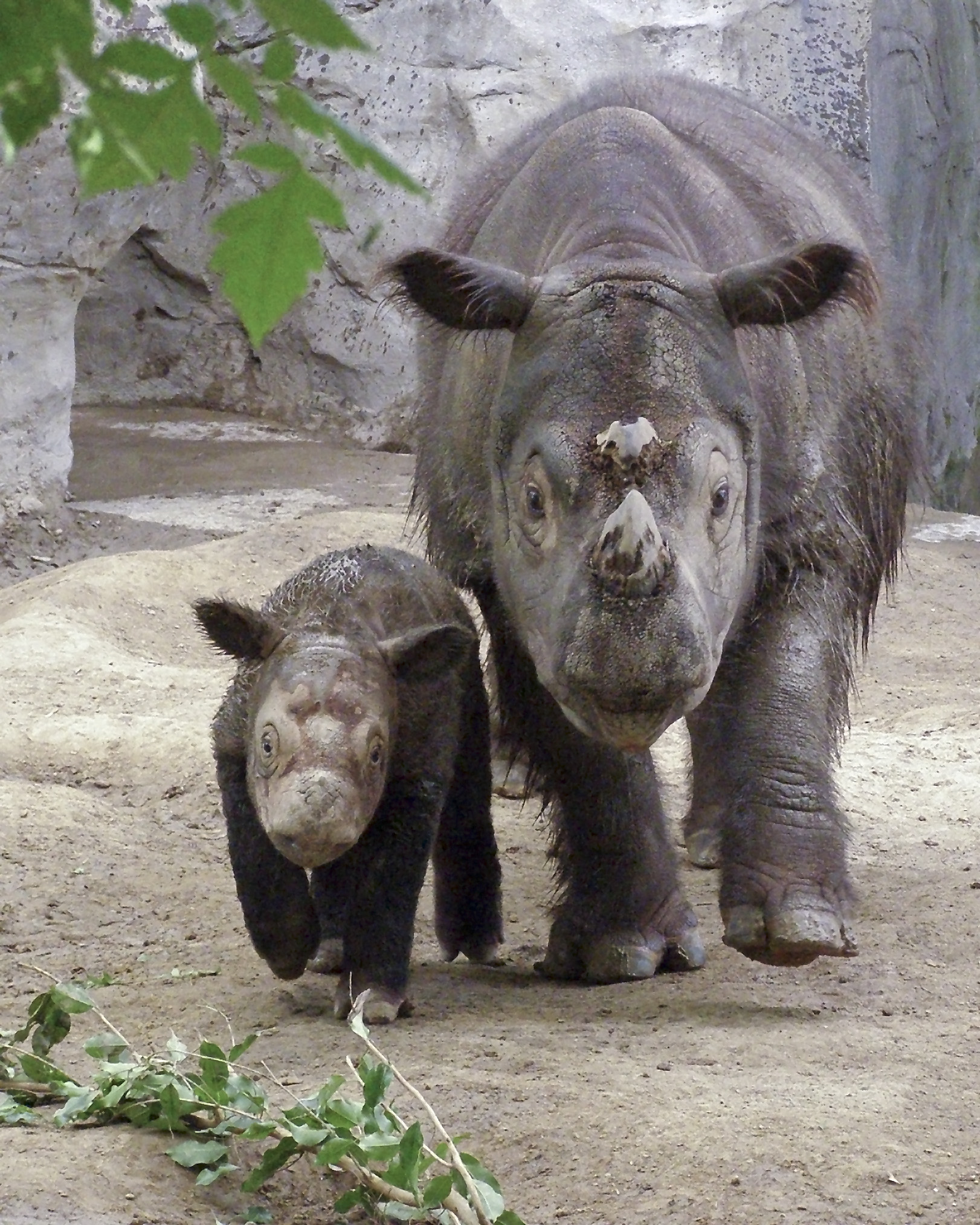
The World’s Hairiest Rhino May Soon Become Extinct


The Sumatran rhino is the smallest of the world’s five living rhinoceros species and the only rhino in Asia with two horns. Although smaller than other rhinos, it is undoubtedly a large, prehistoric looking animal. Unfortunately this unique animal is also classified as one of the most endangered rhinoceros species.

Sumatran rhinos are generally solitary and secretive creatures that feed on leaves, twigs, fruit, and shrubs. The rhinos are most often found near water, and spend much of the day wallowing in the mud, which dries onto the skin. This is cooling and also protects its delicate surface areas from flies and other biting insects. At night the rhinos browse on twigs, leaves, fruits, also felling saplings for tender shoots.

The reason why Sumatran rhinos are critically endangered is due to habitat loss and primarily illegal poaching. Those that survive are small, scattered and under threat from poaching for the traditional medicine trade. Hunting for its horns is a major threat to this species. Sumatran rhinoceros populations are now so small that breeding is rare. International trade in the Sumatran rhinoceros is banned under its listing on Appendix I of CITES, and the species is lawfully protected in all countries where it takes place. Captive breeding of Sumatran rhinos has only in recent times shown any success. International efforts to prevent poaching are believed to be the best hope for the future of this unique and rare mammal.

When will the Humans understand that if things keep on going the way they are, the world's last hairy rhinoceros may soon become extinct!

Sunday, 30 June 2013

One Of The Noisiest Insects In The Insect World


For having relatevly small bodies, Cicadas are one of the noisiest insects in the insect world. When many Cicadas are singing together the sound can be defeaning. Only male Cicadas produce clicking and chirping noices while performing mating calls that can be heard by females up to 1.6 kilimeters
(1 mile) away.

Male Cicadas produce their calls from the rapid vibration of the ribbed drumlike plates called tymbals located on either side of their abdomens (rear body section). Each tymbal is composed of stiff material and is shaped into a curve. When a muscle pulls on the tymbal, it pops into a curve that bends the other way. That movement makes a click. When the muscle relaxes, the tymbals return back to their original shape. The tymbals are clicked many rimes per second.

Did you Know?
In China, male Cicadas are kept in cages at pets. People like to listen to the insect's calls. Female Cicadas are not kept in cages because only male Cicadas sing.

Do Giant Horntail's Give You Nasty Stings?


The Giant Horntail is a massive type of sawfly. Sawfles are relatives of Wasps, Bees and Ants. The Horntail and many other Sawflies are unmistakeable insects if seen (they have the familiar yellow and black colouring of stinging Wasps and Bees). However, Sawflies can look frightening because the females have a long 'sting' sticking out of their abdomens (rear sections). However this spike is not a stinger. Unlike some Wasps, Bees and Ants, Sawflies are incapable of stinging. Instead, the spike, known as an ovipositor, is a tube through which she lays her eggs. A Sawfly's ovipositor often resembles a saw-blade, which the Sawfly uses to drill holes deep into the wood. The eggs are laid in the wood, especially pine. The larvae live in the wood of pine trees, where they spend up to two years or possibly more developing.

Tuesday, 7 May 2013

The Eared Pigmy Tyrant (Myiornis auricularis)


One of the smallest of all Tyrant flycatchers, the Eared Pigmy Tyrant (Myiornis auricularis) weighs over less than some hummingbirds. It has a rounded grey head, and the most noticeable feature of its plumage is the large, crescent-shaped black ear patch, which gives the species its common name. It is found in the forest of Argentina, Brazil, and Paraguay. 

Length
7 ~ 7.5 cm 

Weight: 5g 

Migration
Non-migrant 

Habitat
Subtropical or tropical moist lowland forests and heavily degraded former forest.

Saturday, 4 May 2013

Baby Elephant Wallows In The Mud...


A baby elephant wallows in the mud, but then found himself unable to stand up again. Heavy rain in the Masai Mara created the perfect mud hole, and the youngster wasted no time in going for a roll. However, when he tried to get to his feet again, he was simply unable to stand and kept slipping over. The moment was captured on camera by professional wildlife photographer Andy Rouse, who had been following the herd.

Picture: Andy Rouse / Rex Features

Three Year Old Interacts With Beluga Whale


Three-year-old Veronica Antov interacts with a beluga whale at Mystic Aquarium in Connecticut, US. While Veronica ran along the stretch of the tank's window the whale shadowed her and 'kissed' Veronica by opening his mouth and putting it up to the window.

Picture: Andrey Antov/Solent News & Photo

Thursday, 18 April 2013

The Penduline Tits


Most species of the Penduline Tit family are found in Eurasia, Africa, and Noth America. The name “Penduline” is derived from their cute pendulous bag-shaped nests, which hang from reeds or trees, normally over water. All have short, somewhat fragile pointed bills allowing them to take insects, spiders, and small seeds.

These docile little birds are constantly active, foraging over reeds, twigs, and leaves, and keeping in contact with one another with thin, sibilant calls. Penduline Tits are generally found in pairs or small groups. Eurasian Penduline Tits may be monogamous or a single male may mate with more than one female and a female with more than one male. In other species, the large numbers of eggs in one nest, suggest that more than one female may contribute.

Saturday, 16 March 2013

World Water Day - 2013


International World Water Day is held every year on 22 March as a means of increasing people's attention on the importance of freshwater and advocating for the sustainable management of freshwater resources.

An international day to celebrate freshwater was recommended at the 1992 United Nations Conference on Environment and Development (UNCED). The United Nations General Assembly responded by designating 22 March 1993 as the first World Water Day in light of the increase in demand for water access, allocation and services. 

The Year will highlight the history of successful water cooperation initiatives, as well as identify burning issues on water education, water diplomacy, trans-boundary water management, financing cooperation, national/international legal frameworks, and the linkages with the Millennium Development Goals. It also will provide an opportunity to capitalize on the momentum created at the United Nations Conference on Sustainable Development (Rio+20), and to support the formulation of new objectives that will contribute towards developing water resources that are truly sustainable. 

WEB LINK: World Water Day

Tuesday, 12 March 2013

The Eyes Of A Wolf


I am but a Wolf, born to be free, 
This should be clear, for all to see, 
I want nothing, but what is rightfully mine, 
Decreed as such, since the beginning of time.

I hold no anger, yet man I fear, 
For man destroys, yet sheds no tear, 
For how can I, have respect for you, 
With all the destruction, that man can do. 

A Poem By Baron Barrymore Halpenny

Friday, 1 February 2013

Pink Geckos Noted For Their Webbed Toes

image credit wikipedia 

Pink Geckos (Pachydactylus-rangei) are noted for their webbed toes, which enable them to run across desert dunes without sinking into the loose sand of their native habitat. These incredibly cute creatures spend their days in deep burrows that they dig in the sand, and venture out to the surface to forage only when the desert’s temperature has dropped at night. 

They are recognized as incompetent hunters because their prey can effortlessly avoid them. However by hunting at night they take advantage of the lack of competition from other lizards during the hours when insects and spiders are off their guard. Their large, bulb-like eyes and vertical pupils help them see very well at night. Like most Geckos, they lack eyelids - instead, the eyes are covered with a transparent scale, called a spectacle, which is cleaned by periodic licking in order to keep them moist. 

Human activities threaten the Geckos survival. People hunt them for food, and in many areas, their habitats have been destroyed. Some laws have been passed that help to protect the lizards.

Friday, 18 January 2013

The Valais Blacknose Sheep


When I first saw images of these docile creatures I thought to myself that they were not real-life sheep! The black patches on their nose (the reason for their name), eyes, ears, knees hock and feet and otherwise light wooly coat make them rather out of the ordinary. So you can imagine my overwhelming joy when I discovered that theses creatures were actually real mountain sheep! 

The Valais Blacknose Sheep (also known as the Wallis Blacknose, Walliser Schwarznaseschaf) is a breed of domestic sheep originating in the Valais region. These sheep have also adapted particularly well to life in high mountains where they are capable of gazing on extremely steep, rocky slopes. They are so cute, don’t you agree?

Thursday, 17 January 2013

Spiders That Throw Nets Over Their Prey


The spiders that you see at home or in your garden catch flying insects in their webs. However, a few days ago as I was sifting through the Internet I came across a small group of spiders that use webs to capture insects on the ground. The colorfully named Orge-faced spiders spin a small casting web between the tips of their four front legs. They hang on a single thread from a branch so they are positioned just above the ground.

When an insect wanders under the motionless hunter, the spider plunges its stretched net-like web downwards to envelop and entangle its unwary passing by insect. If successful, the spider will then silk-wrap the insect, bite and paralyze it, and then feed on it. Net strikes will also be made at flying insects that wander too close. An unused net is now and then stored by hanging it on close by leaves for the following night's hunt, or the spider may possibly eat it. The Ogre-faced spiders are named after their large pair of protruding eyes situated at the front of the head, which let them see extremely well at night.

Friday, 28 December 2012

Beautiful Animal Quotes


These quotes about animals give us a good picture of why we need them in our lives, and why we ought to do everything we can to protect them. If you would like to share with us more quotes, please feel free to add it on the comment list. Thanks!

“I ask people why they have deer heads on their walls. They always say because it's such a beautiful animal. There you go. I think my mother is attractive, but I have photographs of her.”
― Ellen DeGeneres

“The greatness of a nation and its moral progress can be judged by the way its animals are treated.”
― Mahatma Gandhi

“Animals are my friends... and I don't eat my friends.”
― George Bernard Shaw

“A dog is the only thing on earth that loves you more than he loves himself.”
― Josh Billings

It is much easier to show compassion to animals. They are never wicked.
― Haile Selassie

"The question is not, can they reason? Nor, can they talk? But can they suffer?"
― Jeremy Bentham

“You can judge a man's true character by the way he treats his fellow animals.”
― Paul McCartney

“Animals don't hate, and we're supposed to be better than them.”
― Elvis Presley

“If a dog will not come to you after having looked you in the face, you should go home and examine your conscience.”
― Woodrow Wilson

“If you don't own a dog, at least one, there is not necessarily anything wrong with you, but there may be something wrong with your life.”
― Roger Caras

“If slaughterhouses had glass walls, the whole world would be vegetarian.”
― Linda McCartney

“Lots of people talk to animals... Not very many listen though... that's the problem.”
― Benjamin Hoff

"I am in favor of animal rights as well as human rights. That is the way of a whole human being."
 --Abraham Lincoln

“Whoever said you can't buy Happiness forgot little puppies.”
― Gene Hill

“...only someone who'd never been an animal would put up a sign saying not to feed them....”
― Jonathan Safran Foer

“I don't believe in the concept of hell, but if I did I would think of it as filled with people who were cruel to animals.”
― Gary Larson

“An animal's eyes have the power to speak a great language.”
― Martin Buber

“One disadvantage of being a hog is that at any moment some blundering fool may try to make a silk purse out of your wife's ear.”
― J.B. Morton

“You can judge the heart of a man by his treatment of animals.”
― James Beverly

“More often than not, what animals require our protection from are not hurricanes or fires, but abuse at the hands of other people".”
― Julie Klam

Source: www.goodreads.com 
For more animal quotes:  Beautiful Animal Quotes - II

Thursday, 27 December 2012

The Clown Of The Ocean

Atlantic Puffin returning with sand-eels to feed the single chick - image credit 

The Atlantic Puffin is the most colorful auk in North Atlantic, with a large and triangular bill that during the breeding season is red, blue and yellow. It fades in the summer when its outer scales are shed. This bird is mainly black above and white below, with grey to white cheeks and bright red-orange legs and feet. The male is in general slightly larger than the female, but they are colored alike. The curious look of the bird, with its colorful bill and its outstanding piebald plumage, has given rise to nicknames such as '"clown of the ocean" and "sea rooster" 

The Atlantic Puffin is sexually mature at the age of 4 to 5 years. When nesting, the Puffin excavates a burrow deep in the ground. The burrow is often lined with feathers, seaweed or plant matter. Both parents incubate the single-egg (which is produced each year) and rear the young, carrying many small fish, packed cross-wide into their bills, back to the burrow for it to eat. 

These Puffins can dive to depths of up to 70m (200ft) to find the shoaling fish that are its main food. These include sand eels, herring capelins, and sprats which are supplemented by animal plankton in winter.

Thursday, 20 December 2012

Tuesday, 4 December 2012

True Story Of A Baby Orca Who Tried To Befriend People

What happens when a wild baby killer whale tries to make friends with people - not for food, but for companionship? Should humans welcome him or turn away?

I watched an amazing movie last weekend called The Whale. It’s a true story of a young orca – a killer whale – who was nicknamed Luna, and who took people by surprise. Several years ago, when Luna was just a baby, he suddenly appeared all alone in a place called Nootka Sound, on the west coast of Vancouver Island. Luna got separated from its pod. In the movie they compare Luna’s situation to a child that’s meandering around a store, turns around and realizes that his family is nowhere in sight. "He is lost"!

Orcas are social. They normally spend their entire lives with their families, but Luna was lost. An orca that gets separated usually just fades away and dies. But that didn’t happen to Luna - he tried to make friends, but not just any friends – Human Friends! Luna hung around passing boat and on the shore, looking for attention. And many people welcomed him. But this contact did not turn out to be simple. Law and science told people to stay away. Yet the same social instincts that drove Luna to seek companionship also brought people to him, in spite of the law. I don’t know about you, but I would have risked my life getting arrested and dove in the frigid water to play with Luna…

As Luna got close to people, he became both treasured and feared. To natives he was the spirit of a chief. To boaters he was a goofy friend. To conservationists he was a cause. To scientists he was trouble. To officials he was a danger. As conflict and tragedy stained the waters, Luna became a symbol of the world's wildest beauty: easy to love, hard to save. The story of Luna is overwhelming.

I would totally suggest for all you readers to look up this movie and giving it a watch. The Whale – Narrated by Ryan Reynolds.
 

Tuesday, 20 November 2012

Whale Watching In Faial

If you’ve never been close to these awe-inspiring creatures in their natural habitat, the island of Faial is a good place to find out what you’ve been missing. (read more...)
Related Posts Plugin for WordPress, Blogger...