You May Also Like ...

Showing posts with label Facts. Show all posts

Tuesday, 30 June 2015

Interesting Facts About The Mountain Gorilla

Did you know: The fully adult male mountain gorilla is twice as large as the female.

Did you know: The gorilla is shy and retiring rather than ferocious and treacherous. It usually seeks no trouble unless harassed but will valiantly defend its family group if threatened.

Did you know: Mountain gorillas have a slow rate of reproduction. Females give birth for the first time at about age 10 and will have more offspring every three or four years.

Did you know: The most serious threat to gorillas is habitat loss.

Did you know: The gorilla's only known enemies are leopards and humans. Crocodiles are potentially dangerous to lowland gorillas. In western Africa, gorillas are commonly hunted for meat or in retaliation for crop raiding, but in eastern Africa they have been the victims of snares and traps set for antelope and other animals. Poachers have also destroyed entire family groups in their attempts to capture infant gorillas for zoos, while others are killed to sell their heads and hands as trophies.

Did you know: Gorillas are susceptible to various parasites and diseases, especially to pneumonia during the long, cold wet seasons.

Did you know: Gorillas rarely attack humans. But in an encounter a person should stay still and refrain from staring or pointing at the gorilla.

Tuesday, 11 March 2014

What Is A Water Scorpion?


Despite their name, water scorpions (family Nepidae–order Hemipetra) are not a type of scorpion at all. They are in fact, a type of bug. Scorpions have powerful pincers, and water scorpions are named after their large pincer-like forelegs that they use to catch prey in the water. Water scorpions also have long tails that stick out behind the body and look a bit like a scorpion's tail. Unlike a scorpion, the insect does not use its tail as a stinger. Instead, this “tail” made up of two attached respiratory tubes is extended above the surface of water, allowing the animal to take in air. A water scorpion hangs upside down with its “tail” poking out through the surface.

Found world-wide, water scorpions live mainly among the bottom edges of ditches and muddy ponds, where they hide among dead, water-logged leaves and other plant remains in order to catch prey.

Saturday, 28 September 2013

The Bird That Is Known As One Of Nature's True Polyglots


As its scientific name (Mimus polyglottos) suggests, the Northern Mockingbird is one of nature’s true polyglots (polyglottos means “many-tongued”). It imitates not only birds but, it can also imitate dog barks, frog calls, sounds of machinery, whistles, and bells. It is capable of learning sounds quickly, integrating them onto its own song. So diverse is its repertoire, that no two songs are the same. Mimicry is crucial for sexual selection – the larger the male’s repertoire, the greater is its attractiveness to females.

The Northern Mockingbird has pale grey upperparts, dull whitish grey underparts, and a long tail. Its dark wings have two white wing-bars and large white patches which, together with the white tail sides, are clearly visible in flight. Males and females look alike, though only males sing. The Northern Mockingbird is an omnivore, its diet consists of arthropods, earthworms, fruits, seeds, berries, and seldom, lizards.

The Northern Mockingbird is known for its intelligence, in a paper published in 2009, researchers found that mockingbirds were able to recall an individual human who, earlier in the study, had approached and threatened the mockingbirds' nest. Researchers had one participant stand near a mockingbird nest and touch it, while others avoided the nest. Later, the mockingbirds recognized the intruder and exhibited defensive behavior, while ignoring the other individuals. (wikipedia)

The Northern Mockingbird is the only mockingbird commonly found in North America. This bird is mainly a permanent resident, but northern birds may move south during harsh weather. This species has rarely been observed in Europe.

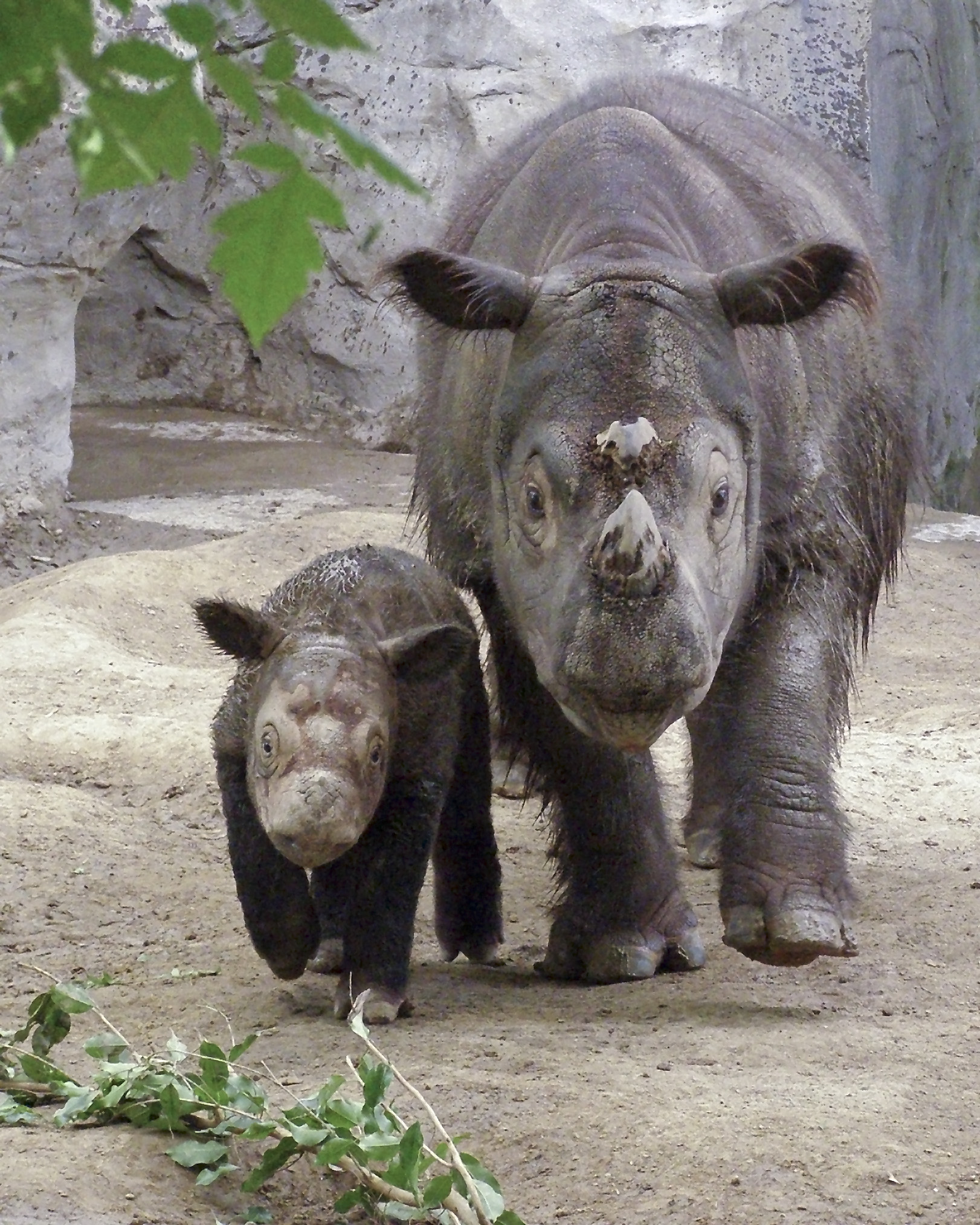
The World’s Hairiest Rhino May Soon Become Extinct


The Sumatran rhino is the smallest of the world’s five living rhinoceros species and the only rhino in Asia with two horns. Although smaller than other rhinos, it is undoubtedly a large, prehistoric looking animal. Unfortunately this unique animal is also classified as one of the most endangered rhinoceros species.

Sumatran rhinos are generally solitary and secretive creatures that feed on leaves, twigs, fruit, and shrubs. The rhinos are most often found near water, and spend much of the day wallowing in the mud, which dries onto the skin. This is cooling and also protects its delicate surface areas from flies and other biting insects. At night the rhinos browse on twigs, leaves, fruits, also felling saplings for tender shoots.

The reason why Sumatran rhinos are critically endangered is due to habitat loss and primarily illegal poaching. Those that survive are small, scattered and under threat from poaching for the traditional medicine trade. Hunting for its horns is a major threat to this species. Sumatran rhinoceros populations are now so small that breeding is rare. International trade in the Sumatran rhinoceros is banned under its listing on Appendix I of CITES, and the species is lawfully protected in all countries where it takes place. Captive breeding of Sumatran rhinos has only in recent times shown any success. International efforts to prevent poaching are believed to be the best hope for the future of this unique and rare mammal.

When will the Humans understand that if things keep on going the way they are, the world's last hairy rhinoceros may soon become extinct!

Thursday, 16 May 2013

Warning! Why Shouldn't You Touch A Tussock Moth Caterpillar?


Tussock moth caterpillars have four brushes of hair on their backs. There are also long, black hairs on their heads. The hairs are a defense system. Touching the hairs can cause painful reactions if they come into contact with skin. The caterpillars have a gland that releases chemicals as a second line of defense. The hairs are left in the cocoon after the caterpillar has changed into an adult. Eggs are laid between the hairs for protection.

Did you Know?
The female rusty tussock moth has no wings. She attracts a mate with fragrance after she emerges from her cocoon. She then lays her eggs inside the empty cocoon. The eggs stay warm inside the cocoon all through winter before hatching in spring. 

Tuesday, 7 May 2013

The Eared Pigmy Tyrant (Myiornis auricularis)


One of the smallest of all Tyrant flycatchers, the Eared Pigmy Tyrant (Myiornis auricularis) weighs over less than some hummingbirds. It has a rounded grey head, and the most noticeable feature of its plumage is the large, crescent-shaped black ear patch, which gives the species its common name. It is found in the forest of Argentina, Brazil, and Paraguay. 

Length: 
7 ~ 7.5 cm 

Weight: 5g 

Migration: 
Non-migrant 

Habitat: 
Subtropical or tropical moist lowland forests and heavily degraded former forest.

Thursday, 18 April 2013

The Penduline Tits


Most species of the Penduline Tit family are found in Eurasia, Africa, and Noth America. The name “Penduline” is derived from their cute pendulous bag-shaped nests, which hang from reeds or trees, normally over water. All have short, somewhat fragile pointed bills allowing them to take insects, spiders, and small seeds.

These docile little birds are constantly active, foraging over reeds, twigs, and leaves, and keeping in contact with one another with thin, sibilant calls. Penduline Tits are generally found in pairs or small groups. Eurasian Penduline Tits may be monogamous or a single male may mate with more than one female and a female with more than one male. In other species, the large numbers of eggs in one nest, suggest that more than one female may contribute.

Thursday, 17 January 2013

Spiders That Throw Nets Over Their Prey


The spiders that you see at home or in your garden catch flying insects in their webs. However, a few days ago as I was sifting through the Internet I came across a small group of spiders that use webs to capture insects on the ground. The colorfully named Orge-faced spiders spin a small casting web between the tips of their four front legs. They hang on a single thread from a branch so they are positioned just above the ground.

When an insect wanders under the motionless hunter, the spider plunges its stretched net-like web downwards to envelop and entangle its unwary passing by insect. If successful, the spider will then silk-wrap the insect, bite and paralyze it, and then feed on it. Net strikes will also be made at flying insects that wander too close. An unused net is now and then stored by hanging it on close by leaves for the following night's hunt, or the spider may possibly eat it. The Ogre-faced spiders are named after their large pair of protruding eyes situated at the front of the head, which let them see extremely well at night.

Thursday, 27 December 2012

How Do Dragonflies See?


Let me remind you not to sneak up on the Dragonfly because it escapes so fast that you would think the insect has eyes in the back of its head! 

Dragonflies are ferocious hunters that catch other insects in mid-air. To do this they need to be skillful flyers and to have excellent vision. A Dragonfly’s eyes allow it to see all around. An insects eye works in a different way to our own. Dragonflies have compound eyes – each an array of up to 28.500 smaller units. Each unit has its own lens and forms an image. The Dragonfly’s brain merges the many images into one composite picture of its surroundings. Compound eyes are especially good at picking up something that is moving. 

Did you know? 
Dragonflies are the closest thing the natural world has got to a helicopter. The insects do not simply flap their wings, but twist them back and forth to create a little vortex, or whirlwind, that lifts the insect.

The Clown Of The Ocean

Atlantic Puffin returning with sand-eels to feed the single chick - image credit 

The Atlantic Puffin is the most colorful auk in North Atlantic, with a large and triangular bill that during the breeding season is red, blue and yellow. It fades in the summer when its outer scales are shed. This bird is mainly black above and white below, with grey to white cheeks and bright red-orange legs and feet. The male is in general slightly larger than the female, but they are colored alike. The curious look of the bird, with its colorful bill and its outstanding piebald plumage, has given rise to nicknames such as '"clown of the ocean" and "sea rooster" 

The Atlantic Puffin is sexually mature at the age of 4 to 5 years. When nesting, the Puffin excavates a burrow deep in the ground. The burrow is often lined with feathers, seaweed or plant matter. Both parents incubate the single-egg (which is produced each year) and rear the young, carrying many small fish, packed cross-wide into their bills, back to the burrow for it to eat. 

These Puffins can dive to depths of up to 70m (200ft) to find the shoaling fish that are its main food. These include sand eels, herring capelins, and sprats which are supplemented by animal plankton in winter.

Wednesday, 7 November 2012

One Of The World’s Largest Freshwater Turtles


The Alligator Snapping Turtle (Macrochelys temminckii) is currently known as one of the world’s largest freshwater turtle, weighing about 68 to 80 kg. However there have been reports of these formidable turtles weighing over 100kg.

Alligator Snapping Turtles hunt mainly by sitting and waiting motionless in the water with its scissor-shape jaws wide open. The inside of the turtle´s mouth is camouflaged and it possesses a vermiform (literally “worm-like”) appendage on the tip of its tongue used to lure fish. The vermiform tongue imitates the movements of a small wriggling pinkish worm, enticing the prey towards its mouth. The hooked upper and lower beaks are then closed with tremendous speed and force (delivering a powerful bite).

Males spend their entire lives at the bottom of lakes or rivers, but the females leave the water in spring to lay clutches of 10 – 50 spherical eggs, buried in mud or sand. Incubation takes from 100 to 140 days, and hatchlings emerge in the early fall.

Monday, 5 November 2012

Why Are Mole Crickets So Noisy?

image credit Qba From Poland

Mole crickets are burrowing insects. They dig through the soil with their shovel-like forelimbs that are highly developed for burrowing to find food, such as roots and insect grubs. Mole insects have shorter feelers than other crickets for the reason that there is no room for them in tight burrows. Mole crickets are one of the noisiest insects in the world. The male calls to attract mates. These calls can be heard hundreds of meters away – not bad at all for an insect that is about 3 to 5 centimeters long! The crickets rub their fore-wings together to make high pitched clicks. Their burrows make the calls louder as each burrow is carefully sculptured into the shape of a double exponential horn – which acts like a megaphone – sending the calls out into the air. 

Mole crickets are relatively common, but because they are nocturnal and spend nearly all their lives underground in extensive tunnel systems, they are rarely seen. However, in some places, mole cricket numbers are declining due to soil erosion and habitat destruction.

Monday, 27 August 2012

Most Beautiful Of All Squirrels Found In India


The Indian giant squirrel (Ratufa indica) is a large tree squirrel species native to India. This extremely beautiful squirrel has a huge bushy tail (about 60cm in length) which is usually longer than the head and body combined. It has a very conspicuous multiple toned color scheme. The upper-parts are dark (brown, black or dark red), the head and limbs are red-brown, and the underside creamy-beige. 

This squirrel, alert and wary of any unusual sight and sound, makes massive leaps of 6m (20ft) among branches as it goes from tree to tree searching for food such as fruit, nuts, bark, insects, and eggs. Its characteristic feeding pasture is not upright but leaning forwards or down, perched on its back legs with the tail as a counterbalance. Its short wide thumbs help it to manipulate food. 

The Indian Giant Squirrel lives alone or in pairs. It builds the typical squirrel type nest - large and globular with twigs and leaves - for resting and rearing young. Reproduction in this species is not certain but they are thought to breed throughout the year. Females usually produce 1-2 offspring in each litter after a gestation period of 28-35 days.

Saturday, 25 August 2012

The Naked Mole Rat


The naked mole-rat (Heterocephalus glaber) is a burrowing rodent native to parts of East Africa. These rodents live in communities very similar to insect societies (such as certain bee species). Several dozen rats live together in colonies led by one dominant female (the queen) which is the only naked mole-rat female to breed and bear young, whereas the rest of the members of the colony function as workers. 

Colonies comprise 70 to 80 individuals that inhabit elaborate tunnel systems. The tunnel systems built by naked mole-rats can stretch up to two or three miles in cumulative length. New tunnels are dug regularly for roots, bulbs, tubers, and other underground plant parts. 

The naked mole-rat is not truly naked but has pale, sparse hairs over its wrinkled pinkish grey skin. They rely on these sensitive hairs to feel their way through their underground burrows. As in other mole-rats, the large protruding teeth are for digging and eating, and the eyes and ears are minute. The tail is rounded and the limbs strong, with 5 thick-clawed toes, for digging. The naked mole-rat is also of interest due to its extraordinarily long-lived for a rodent of its size (about 8-10cm in length excluding tail length) and holds the record for the longest living rodent (up to 28 years).

Saturday, 11 August 2012

Snake With A False Head

image credit wikifaunia.com

Did you know that the Calabar Ground Boa (Charina reinhardtii) is pretty famous for its defensive behavior because of its extraordinary blunt head and equally blunt tail that are hard to tell apart? When threatened, it rolls into a tight ball with its head safely protected in the center of the coils and raises its tail as a false head in order to protect its real head (as shown on above image).

The Calabar Ground Boa can reach a maximum length of approximately 80 – 100 cm. Its scales are black or dark brown, scattered with red or orange. The tail may be ringed or have a partial ring of bright white scales. The Boas small mouth is not suited to large prey, thus it hunts on small mammals, often invading their tunnels and nests. It may wait for the adults to leave the nest, after which it will enter to eat whole litters at a time. 

Calabar Boas are a burrowing species, and hardly ever come above ground during daylight hours. On the other hand, they can be extremely active at night, and under a red night lamp can be a very fascinating species to observe….

Monday, 23 July 2012

Cute Frog With White Lips!

image credit jj harrison via wikipedia 

Wow… what an incredibly cute frog! With a distinctive white stripe that runs along its lower lip, this tropical species which is known as the White-lipped tree frog is one of the biggest “tree frogs" in the world. Found in forests and gardens, it feeds after dark on insects and other arthropods. As shown on the image, the White-lipped tree frog has large adhesive discs on its toes which assist it while climbing. It spends much of its life in trees, thus being agile when moving among vegetation, but on the other hand, it does not move as well on the ground. During the breeding season, adults descend and females lay about 400 or more eggs in the water. The tadpoles feed on aquatic plants and algae and when they have metamorphosed into frogs they leave the water and make their way up into the trees. 

The White-lipped tree frog (Litoria infrafrenata) is on the IUCN Red List for Endangered Species as Least Concern (LC). It has a wide distribution and is adapted to many different habitats.

Monday, 9 July 2012

How Did The Deathwatch Beetle Get Its Name?

image credit wikimedia 

I must admit that very few insects have a name as interesting as the "deathwatch beetle". These little beetles are dangerous pest given that their larvae (young) eat wood. The larvae leave a network of tunnels inside that makes the wood very fragile. It is said that if the insects get into the timbers holding up a house, the beetles can actually make it fall down. 

The deathwatch beetles name comes from the way the beetles tap or tick out messages while feeding on wood. The noises are very quiet, and according to tradition they are heard when people wait in silence around the bed of a dying person. The beetle’s taps were thought to be the ticks of a clock counting down to the end of the person’s life …

The World's Smallest Possum

image credit wikispaces.com

Have a look at the world’s smallest possum, which is known as the Tasmanian pygmy possum, or the Little pygmy possum. This incredibly cute creature has a thumb sized body, with a prehensile tail that can support its entire weight, and widens at its base to store excess food as fat. It is the only pygmy-possum with grey fur on the underside; the under parts are fawn or brown. It has a short snout with long whiskers, and large, erect hairless ears. The eyes are directed forward and surrounded by slightly darker fur. 

Nocturnal and generally solitary, this marsupial feeds in low bushes and shrubs, or on the ground, on a variety of small animals from lizards to insects. Although a good climber, it rarely ventures into the higher branches of trees, most probably because this would make it more susceptible to avian predators.

The Extremely Cute Squirrel Gliders

image credit wikipedia 

Squirrel gliders can glide as far as 50m (165ft) from tree to tree due to their furry gliding membrane which extends from each fifth front toe to the back foot on both sides. The long, bushy, soft-furred, squirrel-like tale can act as a rudder, allowing them to steer which direction they want to go. This extremely cute animal is endemic to Australia, and usually lives in small groups of one adult male, 1-3 females, and their offspring of the season. It feeds mostly on fruit and insects, as well as tree sap, gum, leaves, bark, pollen and seeds. The 1-2 young remain in the pouch for about 3 months and are weaned off by the mother around 4 months.

Unfortunately, the species is threatened due to humans clearing and breaking up their habitation. It also has predators of cats, dogs, owls, and foxes. This causes the species to be put on the Near Threatened list, meaning it is close to being a threatened species.

Monday, 2 July 2012

Is This A Sea Monster?


The Giant oarfish, also known as the King of herrings may well be the longest bony fish alive, reaching an amazing length of up to 17 meters (listed in the Guinness Book of World Records). This astonishing creature is thought to be the inspiration of many myths of sea serpents and sea monsters – even the Loch-Ness monster. To many people, the oarfish may look frightening, but it is in fact harmless - it has no visible teeth and its diet consists of small crustaceans and zooplankton. 

Oarfish are actually remarkable creatures. They have long, laterally flattened, silvery blue bodies, and brilliant crimson fins. The first few rays of the long fringing dorsal fin that runs the entire length of the body form a spectacular crest on the head. According to recent accounts, the oarfish maintains a vertical position in the water, propelling itself slowly with rippling movements of the dorsal fin. The long ribbon-like pelvic fins, meanwhile, are held out to the sides as stabilizers. 

Sightings of live oartfish are extremely rare - this is because it lives in depths of 300 to 1000 meters and hardly ever appears near surface. Oarfish are most often encountered washed up on land either dead or dying in shallow waters. However, when an oarfish is sighted, it usually stirs considerable public attention, but the species has no commercial value, and its gelatinous flesh is not considered edible.
Related Posts Plugin for WordPress, Blogger...