You May Also Like ...

Showing posts with label Knowledge. Show all posts

Tuesday, 30 June 2015

Interesting Facts About The Mountain Gorilla

Did you know: The fully adult male mountain gorilla is twice as large as the female.

Did you know: The gorilla is shy and retiring rather than ferocious and treacherous. It usually seeks no trouble unless harassed but will valiantly defend its family group if threatened.

Did you know: Mountain gorillas have a slow rate of reproduction. Females give birth for the first time at about age 10 and will have more offspring every three or four years.

Did you know: The most serious threat to gorillas is habitat loss.

Did you know: The gorilla's only known enemies are leopards and humans. Crocodiles are potentially dangerous to lowland gorillas. In western Africa, gorillas are commonly hunted for meat or in retaliation for crop raiding, but in eastern Africa they have been the victims of snares and traps set for antelope and other animals. Poachers have also destroyed entire family groups in their attempts to capture infant gorillas for zoos, while others are killed to sell their heads and hands as trophies.

Did you know: Gorillas are susceptible to various parasites and diseases, especially to pneumonia during the long, cold wet seasons.

Did you know: Gorillas rarely attack humans. But in an encounter a person should stay still and refrain from staring or pointing at the gorilla.

Sunday, 28 June 2015

Interesting Facts About Elephants

Did you know: The African elephant and the Asian elephant are the only two surviving species of what was in prehistoric times a diverse and populous group of large mammals.

Did you know: The African elephant is the largest living land mammal.

Did you know: Both male and female African elephants have tusks, although only males in the Asiatic species have them.

Did you know: The African elephant's ears are over twice as large as the Asian elephant's and have a different shape, often described as similar to a map of Africa.

Did you know: The sole of the elephant's foot is covered with a thick, cushion-like padding that helps sustain weight, prevents slipping and deadens sound.

Did you know: Elephants are very social, frequently touching and caressing one another and entwining their trunks.

Did you know: Elephants demonstrate concern for members of their families they take care of weak or injured members and appear to grieve over a dead companion.

Did you know: Females mature at about 11 years and stay in the group, while the males, which mature between 12 and 15, are usually expelled from the maternal herd.

Did you know: Sometimes it is difficult for the layman to distinguish between male and female elephants as the male has no scrotum (the testes are internal), and both the male and the female have loose folds of skin between the hind legs. Unlike other herbivores, the female has her two teats on her chest between her front legs.

Did you know: Of all its specialized features, the muscular trunk is the most remarkable it serves as a nose, a hand, an extra foot, a signaling device and a tool for gathering food, siphoning water, dusting, digging and a variety of other functions. Not only does the long trunk permit the elephant to reach as high as 23 feet, but it can also perform movements as delicate as picking berries or caressing a companion. It is capable, too, of powerful twisting and coiling movements used for tearing down trees or fighting. The trunk of the African elephant has two finger-like structures at its tip, as opposed to just one on the Asian elephant (Elephas maximus).

Saturday, 26 April 2014

Rare White Animals

Animals are beautiful, but there’s something extra special about the creatures shown below.
Fore more images go to www.reshareworthy.com 

Snowflake The Gorilla

Claude The Alligator

Lion

Moose

Vulture

Tuesday, 11 March 2014

What Is A Water Scorpion?


Despite their name, water scorpions (family Nepidae–order Hemipetra) are not a type of scorpion at all. They are in fact, a type of bug. Scorpions have powerful pincers, and water scorpions are named after their large pincer-like forelegs that they use to catch prey in the water. Water scorpions also have long tails that stick out behind the body and look a bit like a scorpion's tail. Unlike a scorpion, the insect does not use its tail as a stinger. Instead, this “tail” made up of two attached respiratory tubes is extended above the surface of water, allowing the animal to take in air. A water scorpion hangs upside down with its “tail” poking out through the surface.

Found world-wide, water scorpions live mainly among the bottom edges of ditches and muddy ponds, where they hide among dead, water-logged leaves and other plant remains in order to catch prey.

Saturday, 28 September 2013

The Bird That Is Known As One Of Nature's True Polyglots


As its scientific name (Mimus polyglottos) suggests, the Northern Mockingbird is one of nature’s true polyglots (polyglottos means “many-tongued”). It imitates not only birds but, it can also imitate dog barks, frog calls, sounds of machinery, whistles, and bells. It is capable of learning sounds quickly, integrating them onto its own song. So diverse is its repertoire, that no two songs are the same. Mimicry is crucial for sexual selection – the larger the male’s repertoire, the greater is its attractiveness to females.

The Northern Mockingbird has pale grey upperparts, dull whitish grey underparts, and a long tail. Its dark wings have two white wing-bars and large white patches which, together with the white tail sides, are clearly visible in flight. Males and females look alike, though only males sing. The Northern Mockingbird is an omnivore, its diet consists of arthropods, earthworms, fruits, seeds, berries, and seldom, lizards.

The Northern Mockingbird is known for its intelligence, in a paper published in 2009, researchers found that mockingbirds were able to recall an individual human who, earlier in the study, had approached and threatened the mockingbirds' nest. Researchers had one participant stand near a mockingbird nest and touch it, while others avoided the nest. Later, the mockingbirds recognized the intruder and exhibited defensive behavior, while ignoring the other individuals. (wikipedia)

The Northern Mockingbird is the only mockingbird commonly found in North America. This bird is mainly a permanent resident, but northern birds may move south during harsh weather. This species has rarely been observed in Europe.

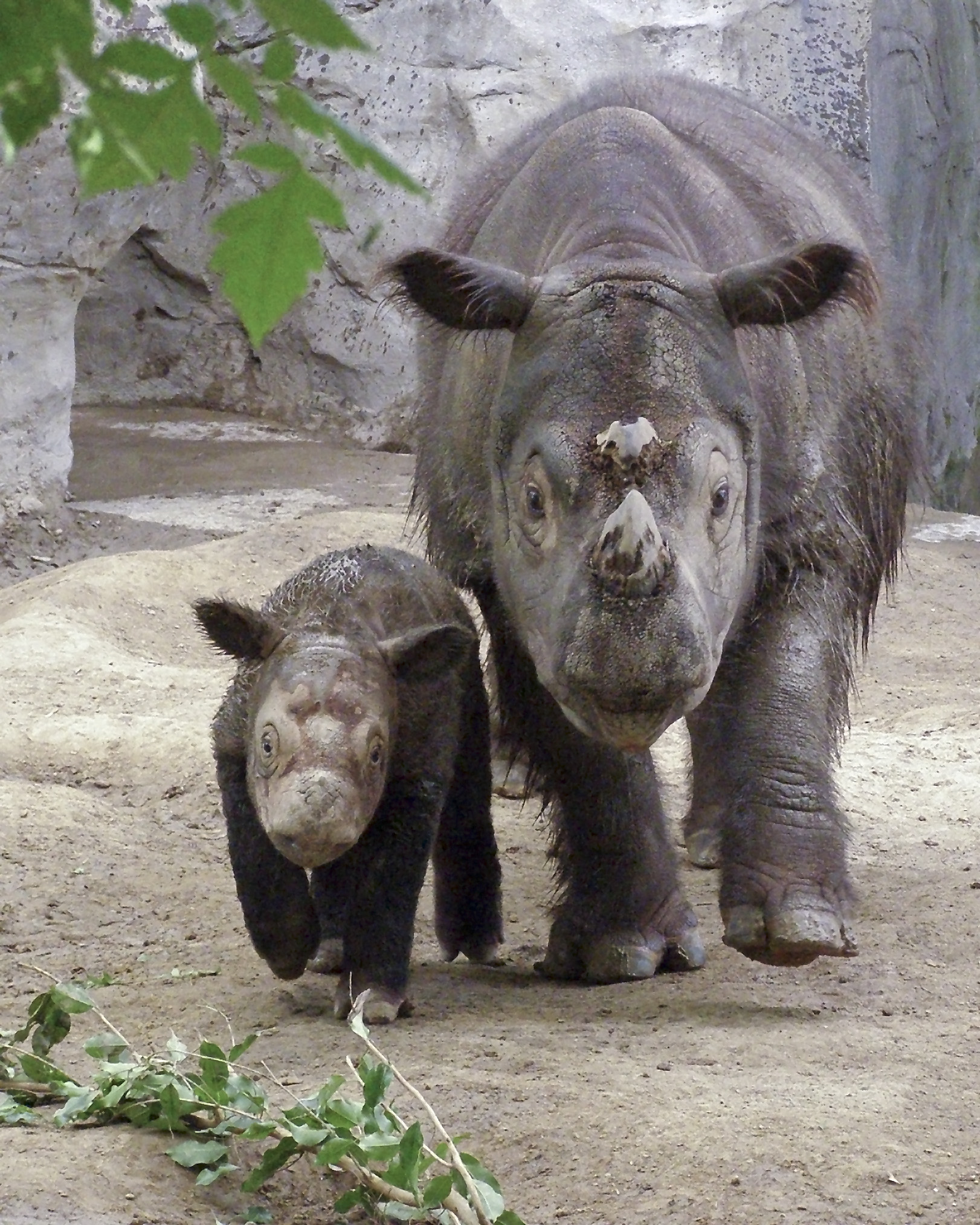
The World’s Hairiest Rhino May Soon Become Extinct


The Sumatran rhino is the smallest of the world’s five living rhinoceros species and the only rhino in Asia with two horns. Although smaller than other rhinos, it is undoubtedly a large, prehistoric looking animal. Unfortunately this unique animal is also classified as one of the most endangered rhinoceros species.

Sumatran rhinos are generally solitary and secretive creatures that feed on leaves, twigs, fruit, and shrubs. The rhinos are most often found near water, and spend much of the day wallowing in the mud, which dries onto the skin. This is cooling and also protects its delicate surface areas from flies and other biting insects. At night the rhinos browse on twigs, leaves, fruits, also felling saplings for tender shoots.

The reason why Sumatran rhinos are critically endangered is due to habitat loss and primarily illegal poaching. Those that survive are small, scattered and under threat from poaching for the traditional medicine trade. Hunting for its horns is a major threat to this species. Sumatran rhinoceros populations are now so small that breeding is rare. International trade in the Sumatran rhinoceros is banned under its listing on Appendix I of CITES, and the species is lawfully protected in all countries where it takes place. Captive breeding of Sumatran rhinos has only in recent times shown any success. International efforts to prevent poaching are believed to be the best hope for the future of this unique and rare mammal.

When will the Humans understand that if things keep on going the way they are, the world's last hairy rhinoceros may soon become extinct!

The Spectacular Wilson’s Bird-of-Paradise


The Wilson's Bird-of-paradise (Cicinnurus respublica), is a very small, up to about 16 cm, passerine bird of the Paradisaeidae family.

The spectacular male Wilson’s Bird-of-Paradise has a bare blue crown with criss-crossing lines on it. The turquoise blue of its head is said to be so vivid that it is clearly visible at night. It has a yellow mantle on its neck, a crimson back, a mixture of blackish-brown/crimson wings, emerald green breast, a light green mouth, and bright blue feet. Its short tail is black and it has two spiraling tail feathers. The female is much less ornately adorned than the male - a brownish bird with a bare blue crown and black head. The female also lacks the spiral tail feathers. Immature males are very similar in appearance to the female. However, the inconspicuous behavior of this species means that it is more easily located by its calls.

The male chooses a display ground, usually a small clearing in dense forest, which he must tidy, by removing leaves and litter. The emerald green breast-shield is thrust forward, and the spiral tail feathers flicked during the display.

An Indonesian endemic, the Wilson's Bird-of-paradise is distributed to the hill and lowland rainforests of Waigeo and Batanta Islands off northern West Papua (formerly Irian Jaya), Indonesia. The diet consists mainly of fruits and also some small insects.

Due to ongoing habitat loss, limited range and exploitation, the Wilson's Bird-of-paradise is evaluated as Near Threatened on the IUCN Red List of Threatened Species. It is listed on Appendix II of CITES.

Sunday, 30 June 2013

One Of The Noisiest Insects In The Insect World


For having relatevly small bodies, Cicadas are one of the noisiest insects in the insect world. When many Cicadas are singing together the sound can be defeaning. Only male Cicadas produce clicking and chirping noices while performing mating calls that can be heard by females up to 1.6 kilimeters
(1 mile) away.

Male Cicadas produce their calls from the rapid vibration of the ribbed drumlike plates called tymbals located on either side of their abdomens (rear body section). Each tymbal is composed of stiff material and is shaped into a curve. When a muscle pulls on the tymbal, it pops into a curve that bends the other way. That movement makes a click. When the muscle relaxes, the tymbals return back to their original shape. The tymbals are clicked many rimes per second.

Did you Know?
In China, male Cicadas are kept in cages at pets. People like to listen to the insect's calls. Female Cicadas are not kept in cages because only male Cicadas sing.

Do Giant Horntail's Give You Nasty Stings?


The Giant Horntail is a massive type of sawfly. Sawfles are relatives of Wasps, Bees and Ants. The Horntail and many other Sawflies are unmistakeable insects if seen (they have the familiar yellow and black colouring of stinging Wasps and Bees). However, Sawflies can look frightening because the females have a long 'sting' sticking out of their abdomens (rear sections). However this spike is not a stinger. Unlike some Wasps, Bees and Ants, Sawflies are incapable of stinging. Instead, the spike, known as an ovipositor, is a tube through which she lays her eggs. A Sawfly's ovipositor often resembles a saw-blade, which the Sawfly uses to drill holes deep into the wood. The eggs are laid in the wood, especially pine. The larvae live in the wood of pine trees, where they spend up to two years or possibly more developing.

Thursday, 13 June 2013

Weird Looking Sea Creatures


An alert Angler-fish swims in the dark, cool waters nearby the Norway’s Lofoten Islands. The fish has shapeless skin and a distinctive face but is best recognized for its method of feeding itself. While traveling the seafloor, the fish makes use of a built-in rod with a tempting filament “lure” that catches the attention of small fish. 


This striking fish has red lips and fins made for wandering the seafloor nearby the Galápagos Islands. The red-lipped batfish is one of various 60 species of Bat-fishes, “flattened” from life on the seafloor and adapted to stroll on modified pectoral and pelvic fins. Like other Angler-fishes, Bat-fishes also use a built-in fishing rod snout, equipped with a retractable appendage, to attract victims near to their lips.


A vibrantly colored clown Frog-fish boasts its stuff on a reef nearby Bali, Indonesia. Members of the Frog-fish family in general keep a much lower profile, depending on the art of camouflage—even changing colors—to maintain out of sight in their reef homes. Frog-fish show off an array of spots, stripes, warts, and other skin irregularities that allow them to try to be like neighboring plants or rocks.  

Images and Source: ocean.nationalgeographic.com

Thursday, 16 May 2013

Warning! Why Shouldn't You Touch A Tussock Moth Caterpillar?


Tussock moth caterpillars have four brushes of hair on their backs. There are also long, black hairs on their heads. The hairs are a defense system. Touching the hairs can cause painful reactions if they come into contact with skin. The caterpillars have a gland that releases chemicals as a second line of defense. The hairs are left in the cocoon after the caterpillar has changed into an adult. Eggs are laid between the hairs for protection.

Did you Know?
The female rusty tussock moth has no wings. She attracts a mate with fragrance after she emerges from her cocoon. She then lays her eggs inside the empty cocoon. The eggs stay warm inside the cocoon all through winter before hatching in spring. 

Tuesday, 7 May 2013

The Eared Pigmy Tyrant (Myiornis auricularis)


One of the smallest of all Tyrant flycatchers, the Eared Pigmy Tyrant (Myiornis auricularis) weighs over less than some hummingbirds. It has a rounded grey head, and the most noticeable feature of its plumage is the large, crescent-shaped black ear patch, which gives the species its common name. It is found in the forest of Argentina, Brazil, and Paraguay. 

Length: 
7 ~ 7.5 cm 

Weight: 5g 

Migration: 
Non-migrant 

Habitat: 
Subtropical or tropical moist lowland forests and heavily degraded former forest.

Thursday, 18 April 2013

The Penduline Tits


Most species of the Penduline Tit family are found in Eurasia, Africa, and Noth America. The name “Penduline” is derived from their cute pendulous bag-shaped nests, which hang from reeds or trees, normally over water. All have short, somewhat fragile pointed bills allowing them to take insects, spiders, and small seeds.

These docile little birds are constantly active, foraging over reeds, twigs, and leaves, and keeping in contact with one another with thin, sibilant calls. Penduline Tits are generally found in pairs or small groups. Eurasian Penduline Tits may be monogamous or a single male may mate with more than one female and a female with more than one male. In other species, the large numbers of eggs in one nest, suggest that more than one female may contribute.

Saturday, 16 March 2013

World Water Day - 2013


International World Water Day is held every year on 22 March as a means of increasing people's attention on the importance of freshwater and advocating for the sustainable management of freshwater resources.

An international day to celebrate freshwater was recommended at the 1992 United Nations Conference on Environment and Development (UNCED). The United Nations General Assembly responded by designating 22 March 1993 as the first World Water Day in light of the increase in demand for water access, allocation and services. 

The Year will highlight the history of successful water cooperation initiatives, as well as identify burning issues on water education, water diplomacy, trans-boundary water management, financing cooperation, national/international legal frameworks, and the linkages with the Millennium Development Goals. It also will provide an opportunity to capitalize on the momentum created at the United Nations Conference on Sustainable Development (Rio+20), and to support the formulation of new objectives that will contribute towards developing water resources that are truly sustainable. 

WEB LINK: World Water Day

Friday, 1 February 2013

Pink Geckos Noted For Their Webbed Toes

image credit wikipedia 

Pink Geckos (Pachydactylus-rangei) are noted for their webbed toes, which enable them to run across desert dunes without sinking into the loose sand of their native habitat. These incredibly cute creatures spend their days in deep burrows that they dig in the sand, and venture out to the surface to forage only when the desert’s temperature has dropped at night. 

They are recognized as incompetent hunters because their prey can effortlessly avoid them. However by hunting at night they take advantage of the lack of competition from other lizards during the hours when insects and spiders are off their guard. Their large, bulb-like eyes and vertical pupils help them see very well at night. Like most Geckos, they lack eyelids - instead, the eyes are covered with a transparent scale, called a spectacle, which is cleaned by periodic licking in order to keep them moist. 

Human activities threaten the Geckos survival. People hunt them for food, and in many areas, their habitats have been destroyed. Some laws have been passed that help to protect the lizards.

Friday, 18 January 2013

The Valais Blacknose Sheep


When I first saw images of these docile creatures I thought to myself that they were not real-life sheep! The black patches on their nose (the reason for their name), eyes, ears, knees hock and feet and otherwise light wooly coat make them rather out of the ordinary. So you can imagine my overwhelming joy when I discovered that theses creatures were actually real mountain sheep! 

The Valais Blacknose Sheep (also known as the Wallis Blacknose, Walliser Schwarznaseschaf) is a breed of domestic sheep originating in the Valais region. These sheep have also adapted particularly well to life in high mountains where they are capable of gazing on extremely steep, rocky slopes. They are so cute, don’t you agree?

Thursday, 17 January 2013

The Importance of Taking Care Of Your Dog


Although there are many things that you should consider when owning an animal, there are a few key aspects which will make a difference in the health and well-being of the animal consistently. Feeding it a diet that is full of healthy food, making sure that it exercises on a daily basis, and giving it a comfortable place to sleep are all factors that need to be considered. You should also make sure that you are taking care of the animal by grooming them properly (Source: Dog Grooming Products from PetShampoo.com). This can not only make a difference in the way that the dog looks, is also going to likely make a difference in the health of the dog as well as the health of their coat. 

Among all of the dog grooming products that you must choose is going to be the dog shampoo that forms the base for the cleansing process. It is important for you to look at the options that are available and to choose one that is going to suit the dog well. After all, the pet shampoo that you put onto your dog has the potential for getting into their bloodstream. The last thing that you would want to do is to introduce any type of harsh chemicals to the animal which could make them sick. Once you have chosen an organic line of dog shampoo and dog grooming products, choose one that is going to work well on the type of dog that you are grooming. This could be according to the color of their coat or even the type of skin that they have. When you make wise choices, your dog will benefit.

Thursday, 27 December 2012

How Do Dragonflies See?


Let me remind you not to sneak up on the Dragonfly because it escapes so fast that you would think the insect has eyes in the back of its head! 

Dragonflies are ferocious hunters that catch other insects in mid-air. To do this they need to be skillful flyers and to have excellent vision. A Dragonfly’s eyes allow it to see all around. An insects eye works in a different way to our own. Dragonflies have compound eyes – each an array of up to 28.500 smaller units. Each unit has its own lens and forms an image. The Dragonfly’s brain merges the many images into one composite picture of its surroundings. Compound eyes are especially good at picking up something that is moving. 

Did you know? 
Dragonflies are the closest thing the natural world has got to a helicopter. The insects do not simply flap their wings, but twist them back and forth to create a little vortex, or whirlwind, that lifts the insect.

Tuesday, 4 December 2012

True Story Of A Baby Orca Who Tried To Befriend People

What happens when a wild baby killer whale tries to make friends with people - not for food, but for companionship? Should humans welcome him or turn away?

I watched an amazing movie last weekend called The Whale. It’s a true story of a young orca – a killer whale – who was nicknamed Luna, and who took people by surprise. Several years ago, when Luna was just a baby, he suddenly appeared all alone in a place called Nootka Sound, on the west coast of Vancouver Island. Luna got separated from its pod. In the movie they compare Luna’s situation to a child that’s meandering around a store, turns around and realizes that his family is nowhere in sight. "He is lost"!

Orcas are social. They normally spend their entire lives with their families, but Luna was lost. An orca that gets separated usually just fades away and dies. But that didn’t happen to Luna - he tried to make friends, but not just any friends – Human Friends! Luna hung around passing boat and on the shore, looking for attention. And many people welcomed him. But this contact did not turn out to be simple. Law and science told people to stay away. Yet the same social instincts that drove Luna to seek companionship also brought people to him, in spite of the law. I don’t know about you, but I would have risked my life getting arrested and dove in the frigid water to play with Luna…

As Luna got close to people, he became both treasured and feared. To natives he was the spirit of a chief. To boaters he was a goofy friend. To conservationists he was a cause. To scientists he was trouble. To officials he was a danger. As conflict and tragedy stained the waters, Luna became a symbol of the world's wildest beauty: easy to love, hard to save. The story of Luna is overwhelming.

I would totally suggest for all you readers to look up this movie and giving it a watch. The Whale – Narrated by Ryan Reynolds.
 

Wednesday, 7 November 2012

One Of The World’s Largest Freshwater Turtles


The Alligator Snapping Turtle (Macrochelys temminckii) is currently known as one of the world’s largest freshwater turtle, weighing about 68 to 80 kg. However there have been reports of these formidable turtles weighing over 100kg.

Alligator Snapping Turtles hunt mainly by sitting and waiting motionless in the water with its scissor-shape jaws wide open. The inside of the turtle´s mouth is camouflaged and it possesses a vermiform (literally “worm-like”) appendage on the tip of its tongue used to lure fish. The vermiform tongue imitates the movements of a small wriggling pinkish worm, enticing the prey towards its mouth. The hooked upper and lower beaks are then closed with tremendous speed and force (delivering a powerful bite).

Males spend their entire lives at the bottom of lakes or rivers, but the females leave the water in spring to lay clutches of 10 – 50 spherical eggs, buried in mud or sand. Incubation takes from 100 to 140 days, and hatchlings emerge in the early fall.
Related Posts Plugin for WordPress, Blogger...