You May Also Like ...

Showing posts with label wildlife. Show all posts

Tuesday, 30 June 2015

Interesting Facts About The Mountain Gorilla

Did you know: The fully adult male mountain gorilla is twice as large as the female.

Did you know: The gorilla is shy and retiring rather than ferocious and treacherous. It usually seeks no trouble unless harassed but will valiantly defend its family group if threatened.

Did you know: Mountain gorillas have a slow rate of reproduction. Females give birth for the first time at about age 10 and will have more offspring every three or four years.

Did you know: The most serious threat to gorillas is habitat loss.

Did you know: The gorilla's only known enemies are leopards and humans. Crocodiles are potentially dangerous to lowland gorillas. In western Africa, gorillas are commonly hunted for meat or in retaliation for crop raiding, but in eastern Africa they have been the victims of snares and traps set for antelope and other animals. Poachers have also destroyed entire family groups in their attempts to capture infant gorillas for zoos, while others are killed to sell their heads and hands as trophies.

Did you know: Gorillas are susceptible to various parasites and diseases, especially to pneumonia during the long, cold wet seasons.

Did you know: Gorillas rarely attack humans. But in an encounter a person should stay still and refrain from staring or pointing at the gorilla.

Sunday, 28 June 2015

Interesting Facts About Elephants

Did you know: The African elephant and the Asian elephant are the only two surviving species of what was in prehistoric times a diverse and populous group of large mammals.

Did you know: The African elephant is the largest living land mammal.

Did you know: Both male and female African elephants have tusks, although only males in the Asiatic species have them.

Did you know: The African elephant's ears are over twice as large as the Asian elephant's and have a different shape, often described as similar to a map of Africa.

Did you know: The sole of the elephant's foot is covered with a thick, cushion-like padding that helps sustain weight, prevents slipping and deadens sound.

Did you know: Elephants are very social, frequently touching and caressing one another and entwining their trunks.

Did you know: Elephants demonstrate concern for members of their families they take care of weak or injured members and appear to grieve over a dead companion.

Did you know: Females mature at about 11 years and stay in the group, while the males, which mature between 12 and 15, are usually expelled from the maternal herd.

Did you know: Sometimes it is difficult for the layman to distinguish between male and female elephants as the male has no scrotum (the testes are internal), and both the male and the female have loose folds of skin between the hind legs. Unlike other herbivores, the female has her two teats on her chest between her front legs.

Did you know: Of all its specialized features, the muscular trunk is the most remarkable it serves as a nose, a hand, an extra foot, a signaling device and a tool for gathering food, siphoning water, dusting, digging and a variety of other functions. Not only does the long trunk permit the elephant to reach as high as 23 feet, but it can also perform movements as delicate as picking berries or caressing a companion. It is capable, too, of powerful twisting and coiling movements used for tearing down trees or fighting. The trunk of the African elephant has two finger-like structures at its tip, as opposed to just one on the Asian elephant (Elephas maximus).

Saturday, 28 September 2013

The Bird That Is Known As One Of Nature's True Polyglots


As its scientific name (Mimus polyglottos) suggests, the Northern Mockingbird is one of nature’s true polyglots (polyglottos means “many-tongued”). It imitates not only birds but, it can also imitate dog barks, frog calls, sounds of machinery, whistles, and bells. It is capable of learning sounds quickly, integrating them onto its own song. So diverse is its repertoire, that no two songs are the same. Mimicry is crucial for sexual selection – the larger the male’s repertoire, the greater is its attractiveness to females.

The Northern Mockingbird has pale grey upperparts, dull whitish grey underparts, and a long tail. Its dark wings have two white wing-bars and large white patches which, together with the white tail sides, are clearly visible in flight. Males and females look alike, though only males sing. The Northern Mockingbird is an omnivore, its diet consists of arthropods, earthworms, fruits, seeds, berries, and seldom, lizards.

The Northern Mockingbird is known for its intelligence, in a paper published in 2009, researchers found that mockingbirds were able to recall an individual human who, earlier in the study, had approached and threatened the mockingbirds' nest. Researchers had one participant stand near a mockingbird nest and touch it, while others avoided the nest. Later, the mockingbirds recognized the intruder and exhibited defensive behavior, while ignoring the other individuals. (wikipedia)

The Northern Mockingbird is the only mockingbird commonly found in North America. This bird is mainly a permanent resident, but northern birds may move south during harsh weather. This species has rarely been observed in Europe.

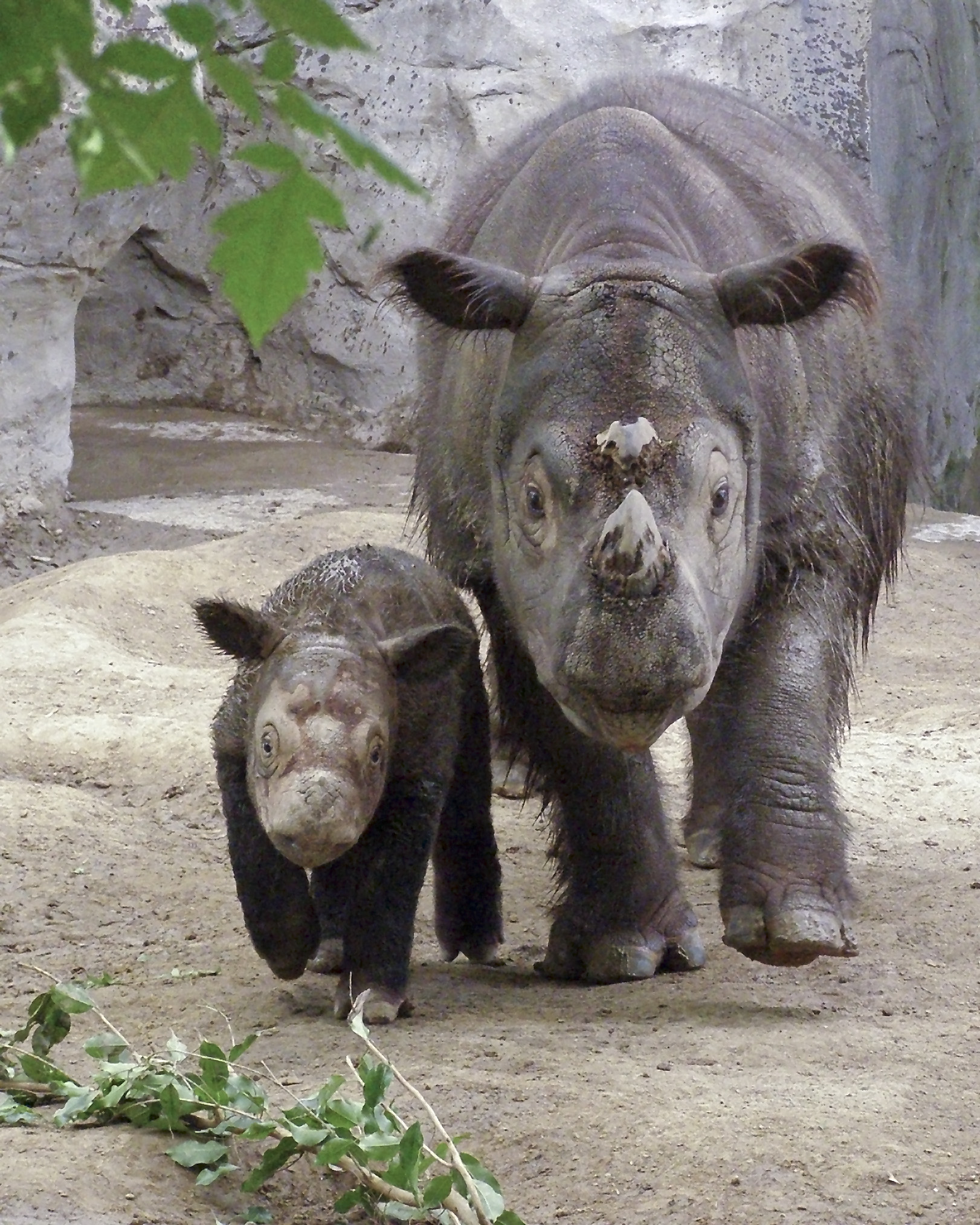
The World’s Hairiest Rhino May Soon Become Extinct


The Sumatran rhino is the smallest of the world’s five living rhinoceros species and the only rhino in Asia with two horns. Although smaller than other rhinos, it is undoubtedly a large, prehistoric looking animal. Unfortunately this unique animal is also classified as one of the most endangered rhinoceros species.

Sumatran rhinos are generally solitary and secretive creatures that feed on leaves, twigs, fruit, and shrubs. The rhinos are most often found near water, and spend much of the day wallowing in the mud, which dries onto the skin. This is cooling and also protects its delicate surface areas from flies and other biting insects. At night the rhinos browse on twigs, leaves, fruits, also felling saplings for tender shoots.

The reason why Sumatran rhinos are critically endangered is due to habitat loss and primarily illegal poaching. Those that survive are small, scattered and under threat from poaching for the traditional medicine trade. Hunting for its horns is a major threat to this species. Sumatran rhinoceros populations are now so small that breeding is rare. International trade in the Sumatran rhinoceros is banned under its listing on Appendix I of CITES, and the species is lawfully protected in all countries where it takes place. Captive breeding of Sumatran rhinos has only in recent times shown any success. International efforts to prevent poaching are believed to be the best hope for the future of this unique and rare mammal.

When will the Humans understand that if things keep on going the way they are, the world's last hairy rhinoceros may soon become extinct!

The Spectacular Wilson’s Bird-of-Paradise


The Wilson's Bird-of-paradise (Cicinnurus respublica), is a very small, up to about 16 cm, passerine bird of the Paradisaeidae family.

The spectacular male Wilson’s Bird-of-Paradise has a bare blue crown with criss-crossing lines on it. The turquoise blue of its head is said to be so vivid that it is clearly visible at night. It has a yellow mantle on its neck, a crimson back, a mixture of blackish-brown/crimson wings, emerald green breast, a light green mouth, and bright blue feet. Its short tail is black and it has two spiraling tail feathers. The female is much less ornately adorned than the male - a brownish bird with a bare blue crown and black head. The female also lacks the spiral tail feathers. Immature males are very similar in appearance to the female. However, the inconspicuous behavior of this species means that it is more easily located by its calls.

The male chooses a display ground, usually a small clearing in dense forest, which he must tidy, by removing leaves and litter. The emerald green breast-shield is thrust forward, and the spiral tail feathers flicked during the display.

An Indonesian endemic, the Wilson's Bird-of-paradise is distributed to the hill and lowland rainforests of Waigeo and Batanta Islands off northern West Papua (formerly Irian Jaya), Indonesia. The diet consists mainly of fruits and also some small insects.

Due to ongoing habitat loss, limited range and exploitation, the Wilson's Bird-of-paradise is evaluated as Near Threatened on the IUCN Red List of Threatened Species. It is listed on Appendix II of CITES.

Thursday, 13 June 2013

Weird Looking Sea Creatures


An alert Angler-fish swims in the dark, cool waters nearby the Norway’s Lofoten Islands. The fish has shapeless skin and a distinctive face but is best recognized for its method of feeding itself. While traveling the seafloor, the fish makes use of a built-in rod with a tempting filament “lure” that catches the attention of small fish. 


This striking fish has red lips and fins made for wandering the seafloor nearby the Galápagos Islands. The red-lipped batfish is one of various 60 species of Bat-fishes, “flattened” from life on the seafloor and adapted to stroll on modified pectoral and pelvic fins. Like other Angler-fishes, Bat-fishes also use a built-in fishing rod snout, equipped with a retractable appendage, to attract victims near to their lips.


A vibrantly colored clown Frog-fish boasts its stuff on a reef nearby Bali, Indonesia. Members of the Frog-fish family in general keep a much lower profile, depending on the art of camouflage—even changing colors—to maintain out of sight in their reef homes. Frog-fish show off an array of spots, stripes, warts, and other skin irregularities that allow them to try to be like neighboring plants or rocks.  

Images and Source: ocean.nationalgeographic.com

Saturday, 4 May 2013

Baby Elephant Wallows In The Mud...


A baby elephant wallows in the mud, but then found himself unable to stand up again. Heavy rain in the Masai Mara created the perfect mud hole, and the youngster wasted no time in going for a roll. However, when he tried to get to his feet again, he was simply unable to stand and kept slipping over. The moment was captured on camera by professional wildlife photographer Andy Rouse, who had been following the herd.

Picture: Andy Rouse / Rex Features

Monday, 29 April 2013

Amazing Close-Up Macro Photograph

 A large ant (Camponotus herculaneus) 

 Amateur bug photographer John Hallmén has been fascinated by insects since he was a young boy. In the last three years John has made a name for himself by photographing the miniature creatures he finds in the Nackareservatet nature reserve close by his home in Stockholm, Sweden. Using a combination of studio and outdoor shots John magnifies the insects to show the stunning color and detail of his subjects. 

Picture: JOHN HALLMÉN / BARCROFT MEDIA
Source: www.telegraph.co.uk

Tuesday, 12 March 2013

The Eyes Of A Wolf


I am but a Wolf, born to be free, 
This should be clear, for all to see, 
I want nothing, but what is rightfully mine, 
Decreed as such, since the beginning of time.

I hold no anger, yet man I fear, 
For man destroys, yet sheds no tear, 
For how can I, have respect for you, 
With all the destruction, that man can do. 

A Poem By Baron Barrymore Halpenny

Friday, 18 January 2013

The Valais Blacknose Sheep


When I first saw images of these docile creatures I thought to myself that they were not real-life sheep! The black patches on their nose (the reason for their name), eyes, ears, knees hock and feet and otherwise light wooly coat make them rather out of the ordinary. So you can imagine my overwhelming joy when I discovered that theses creatures were actually real mountain sheep! 

The Valais Blacknose Sheep (also known as the Wallis Blacknose, Walliser Schwarznaseschaf) is a breed of domestic sheep originating in the Valais region. These sheep have also adapted particularly well to life in high mountains where they are capable of gazing on extremely steep, rocky slopes. They are so cute, don’t you agree?

Thursday, 27 December 2012

How Do Dragonflies See?


Let me remind you not to sneak up on the Dragonfly because it escapes so fast that you would think the insect has eyes in the back of its head! 

Dragonflies are ferocious hunters that catch other insects in mid-air. To do this they need to be skillful flyers and to have excellent vision. A Dragonfly’s eyes allow it to see all around. An insects eye works in a different way to our own. Dragonflies have compound eyes – each an array of up to 28.500 smaller units. Each unit has its own lens and forms an image. The Dragonfly’s brain merges the many images into one composite picture of its surroundings. Compound eyes are especially good at picking up something that is moving. 

Did you know? 
Dragonflies are the closest thing the natural world has got to a helicopter. The insects do not simply flap their wings, but twist them back and forth to create a little vortex, or whirlwind, that lifts the insect.

The Clown Of The Ocean

Atlantic Puffin returning with sand-eels to feed the single chick - image credit 

The Atlantic Puffin is the most colorful auk in North Atlantic, with a large and triangular bill that during the breeding season is red, blue and yellow. It fades in the summer when its outer scales are shed. This bird is mainly black above and white below, with grey to white cheeks and bright red-orange legs and feet. The male is in general slightly larger than the female, but they are colored alike. The curious look of the bird, with its colorful bill and its outstanding piebald plumage, has given rise to nicknames such as '"clown of the ocean" and "sea rooster" 

The Atlantic Puffin is sexually mature at the age of 4 to 5 years. When nesting, the Puffin excavates a burrow deep in the ground. The burrow is often lined with feathers, seaweed or plant matter. Both parents incubate the single-egg (which is produced each year) and rear the young, carrying many small fish, packed cross-wide into their bills, back to the burrow for it to eat. 

These Puffins can dive to depths of up to 70m (200ft) to find the shoaling fish that are its main food. These include sand eels, herring capelins, and sprats which are supplemented by animal plankton in winter.

Tuesday, 4 December 2012

True Story Of A Baby Orca Who Tried To Befriend People

What happens when a wild baby killer whale tries to make friends with people - not for food, but for companionship? Should humans welcome him or turn away?

I watched an amazing movie last weekend called The Whale. It’s a true story of a young orca – a killer whale – who was nicknamed Luna, and who took people by surprise. Several years ago, when Luna was just a baby, he suddenly appeared all alone in a place called Nootka Sound, on the west coast of Vancouver Island. Luna got separated from its pod. In the movie they compare Luna’s situation to a child that’s meandering around a store, turns around and realizes that his family is nowhere in sight. "He is lost"!

Orcas are social. They normally spend their entire lives with their families, but Luna was lost. An orca that gets separated usually just fades away and dies. But that didn’t happen to Luna - he tried to make friends, but not just any friends – Human Friends! Luna hung around passing boat and on the shore, looking for attention. And many people welcomed him. But this contact did not turn out to be simple. Law and science told people to stay away. Yet the same social instincts that drove Luna to seek companionship also brought people to him, in spite of the law. I don’t know about you, but I would have risked my life getting arrested and dove in the frigid water to play with Luna…

As Luna got close to people, he became both treasured and feared. To natives he was the spirit of a chief. To boaters he was a goofy friend. To conservationists he was a cause. To scientists he was trouble. To officials he was a danger. As conflict and tragedy stained the waters, Luna became a symbol of the world's wildest beauty: easy to love, hard to save. The story of Luna is overwhelming.

I would totally suggest for all you readers to look up this movie and giving it a watch. The Whale – Narrated by Ryan Reynolds.
 

Tuesday, 20 November 2012

Whale Watching In Faial

If you’ve never been close to these awe-inspiring creatures in their natural habitat, the island of Faial is a good place to find out what you’ve been missing. (read more...)

Wednesday, 7 November 2012

One Of The World’s Largest Freshwater Turtles


The Alligator Snapping Turtle (Macrochelys temminckii) is currently known as one of the world’s largest freshwater turtle, weighing about 68 to 80 kg. However there have been reports of these formidable turtles weighing over 100kg.

Alligator Snapping Turtles hunt mainly by sitting and waiting motionless in the water with its scissor-shape jaws wide open. The inside of the turtle´s mouth is camouflaged and it possesses a vermiform (literally “worm-like”) appendage on the tip of its tongue used to lure fish. The vermiform tongue imitates the movements of a small wriggling pinkish worm, enticing the prey towards its mouth. The hooked upper and lower beaks are then closed with tremendous speed and force (delivering a powerful bite).

Males spend their entire lives at the bottom of lakes or rivers, but the females leave the water in spring to lay clutches of 10 – 50 spherical eggs, buried in mud or sand. Incubation takes from 100 to 140 days, and hatchlings emerge in the early fall.

Monday, 5 November 2012

Why Are Mole Crickets So Noisy?

image credit Qba From Poland

Mole crickets are burrowing insects. They dig through the soil with their shovel-like forelimbs that are highly developed for burrowing to find food, such as roots and insect grubs. Mole insects have shorter feelers than other crickets for the reason that there is no room for them in tight burrows. Mole crickets are one of the noisiest insects in the world. The male calls to attract mates. These calls can be heard hundreds of meters away – not bad at all for an insect that is about 3 to 5 centimeters long! The crickets rub their fore-wings together to make high pitched clicks. Their burrows make the calls louder as each burrow is carefully sculptured into the shape of a double exponential horn – which acts like a megaphone – sending the calls out into the air. 

Mole crickets are relatively common, but because they are nocturnal and spend nearly all their lives underground in extensive tunnel systems, they are rarely seen. However, in some places, mole cricket numbers are declining due to soil erosion and habitat destruction.

Tuesday, 28 August 2012

You Buy, Elephants Die ....

When you are traveling in a foreign country, or even antique shopping at home, please be on the lookout for ivory. In the past, ivory was used to create artwork, religious items, jewelry boxes and other type of containers that hold objects of value. Today, with great sadness, ivory is still being used to create many objects such as letter openers, pottery (cups and bowls), jewelry (necklaces, pendants and earrings), figurines or decorations, hand-carved ivory panels and so on… Every piece of ivory comes from an elephant that was slaughtered to make it. Please say “NO” to ivory. I firmly believe that poachers would have no reason to kill these elephants if people would just stop buying the ivory…

Elephants are one of the most remarkable animals on this planet. They are extremely emotional animals that have the ability to love profoundly. When baby elephants are saved after losing their mother to poachers, they weep in grief and show signs of immense fear and emotional pain. They can even die from such terrible suffering. I strongly appeal to people all over the world to help spare these remarkable animals from lives of suffering – all you have to do is just say “NO” to ivory…

Monday, 27 August 2012

Most Beautiful Of All Squirrels Found In India


The Indian giant squirrel (Ratufa indica) is a large tree squirrel species native to India. This extremely beautiful squirrel has a huge bushy tail (about 60cm in length) which is usually longer than the head and body combined. It has a very conspicuous multiple toned color scheme. The upper-parts are dark (brown, black or dark red), the head and limbs are red-brown, and the underside creamy-beige. 

This squirrel, alert and wary of any unusual sight and sound, makes massive leaps of 6m (20ft) among branches as it goes from tree to tree searching for food such as fruit, nuts, bark, insects, and eggs. Its characteristic feeding pasture is not upright but leaning forwards or down, perched on its back legs with the tail as a counterbalance. Its short wide thumbs help it to manipulate food. 

The Indian Giant Squirrel lives alone or in pairs. It builds the typical squirrel type nest - large and globular with twigs and leaves - for resting and rearing young. Reproduction in this species is not certain but they are thought to breed throughout the year. Females usually produce 1-2 offspring in each litter after a gestation period of 28-35 days.

Saturday, 11 August 2012

Snake With A False Head

image credit wikifaunia.com

Did you know that the Calabar Ground Boa (Charina reinhardtii) is pretty famous for its defensive behavior because of its extraordinary blunt head and equally blunt tail that are hard to tell apart? When threatened, it rolls into a tight ball with its head safely protected in the center of the coils and raises its tail as a false head in order to protect its real head (as shown on above image).

The Calabar Ground Boa can reach a maximum length of approximately 80 – 100 cm. Its scales are black or dark brown, scattered with red or orange. The tail may be ringed or have a partial ring of bright white scales. The Boas small mouth is not suited to large prey, thus it hunts on small mammals, often invading their tunnels and nests. It may wait for the adults to leave the nest, after which it will enter to eat whole litters at a time. 

Calabar Boas are a burrowing species, and hardly ever come above ground during daylight hours. On the other hand, they can be extremely active at night, and under a red night lamp can be a very fascinating species to observe….

Tuesday, 7 August 2012

A Flying Lizard

While I was sifting through the internet I came across this extraordinary flying lizard that has a pair of wings consisting of skin stretched between elongated ribs (If you have a closer look at the photo you will notice that what looks like veins running through the wings is actually its ribs). These wings help it glide from one tree trunk to another to avoid predators such as birds and snakes. To take off, the lizard moves its ribs outwards and opens the flaps of skin, closing them again on landing. 

The flying lizard is generally tan or pale brown to bright yellow, with a throat flap for display that is large and bright yellow in the male, but small and pale yellow in the female. Highly agile, this lizard lives on tree trunks and actively hunts for ants. The only time a flying lizard leaves the safety of trees is when a female is ready to lay her eggs, which she buries in sand or soil. She then guards the eggs for about 24 hours, but then leaves and has nothing more to do with the offspring. 

Didn’t James Cameron say that the creatures in Avatar came from real-life inspiration? So I guess that this little flying lizard (Draco Spilonotus) has got to be it (hihihi)…
Related Posts Plugin for WordPress, Blogger...